
A primer from Clem
A quiet kitchen primer:
cooking with cannabis.
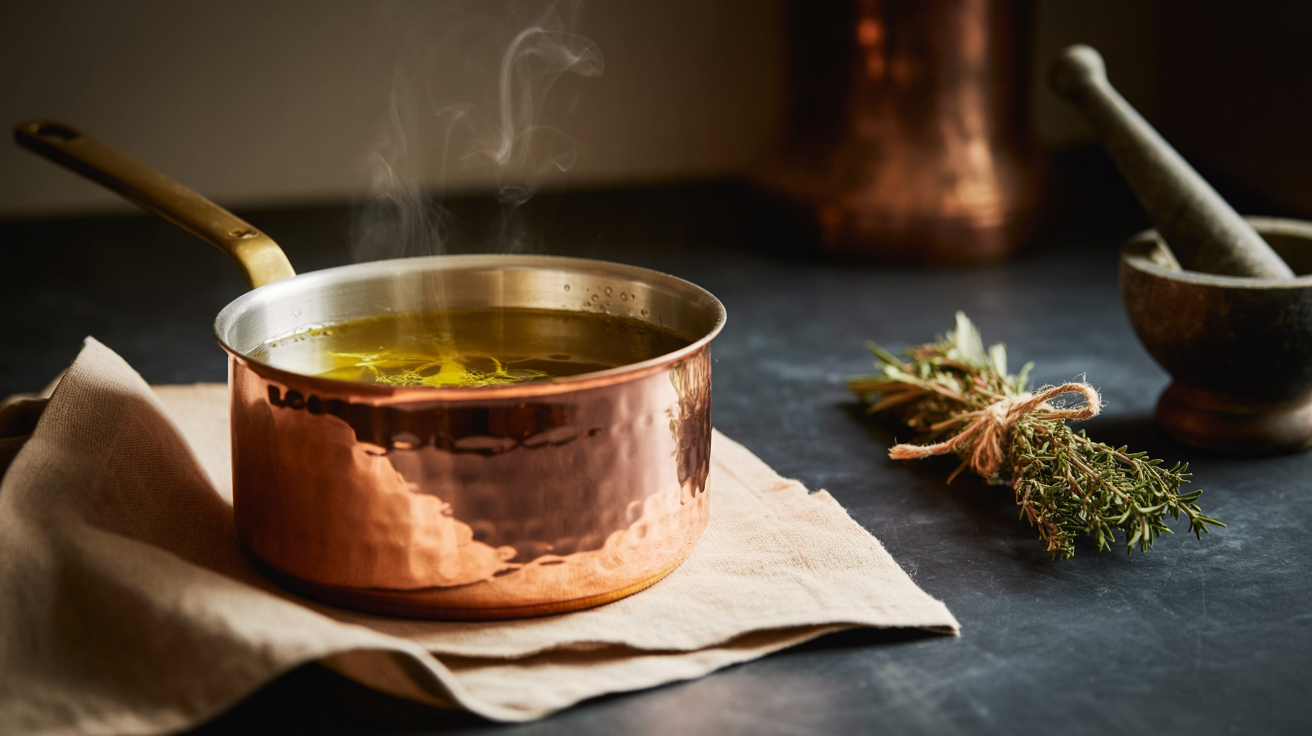
Edibles are not a shortcut. Done well, they're a craft — the same patient infusion that makes vanilla bean butter or rosemary oil. Here's how to make the four staples a Clem's Kitchen recipe will ever ask of you, the math you'll lean on, and the rules of the road you should never break.
Read first. This guide is for adults 21 and over in legal jurisdictions. Educational only — not medical advice. Know your state and local laws. Never consume and drive. Keep finished edibles labeled, dated, and stored where children and pets cannot reach them.
Decarboxylation — wake the molecules up.
Raw cannabis flower carries THC in its acidic form, THCA, which does not produce the effects we associate with edibles. Heat converts THCA → THC. This is decarboxylation, and it is the one step new cooks routinely skip and then wonder why their butter tastes grassy and does nothing.
- Preheat the oven to 240°F (115°C).
- Break flower into small pieces — roughly the size of dried oregano. Smaller is better; powder is too fine.
- Spread on a parchment-lined baking sheet in a single layer.
- Bake for 40 minutes, gently turning the tray once at 20 minutes for even toast.
- The flower should be a deeper, browner shade of green and fragrant. Cool fully before infusing.
A note from Clem: low and slow protects the terpenes — the same molecules that make a strain pair with rosemary or citrus. Burn them off and you're left with strength but no story on the palate.
Cannabutter — the workhorse of the kitchen.
Butter is the most forgiving fat for infusion: high enough fat content to hold cannabinoids, gentle enough flavor to disappear into baked goods, sauces, and pasta. This is the one to learn first.
Yields about 1 cup infused butter
- · 1 cup (2 sticks / 226 g) unsalted butter
- · 1 cup water
- · 7–10 g decarboxylated cannabis flower (see step 1)
- In a small heavy saucepan, combine butter and water over very low heat. The water acts as a temperature buffer so the butter never scorches.
- Once melted, add the decarbed flower. Stir to submerge.
- Maintain a bare simmer — small lazy bubbles, never a rolling boil — for 2 to 3 hours, stirring every 20 minutes.
- Line a fine mesh strainer with a double layer of cheesecloth over a heatproof bowl. Pour the mixture through. Press gently — don't wring.
- Refrigerate until the butter solidifies into a disc on top of the water (2–3 hours). Lift the disc, blot dry, and store.
A note from Clem: the temperature is the whole game. Above 190°F you start losing terpenes; above 230°F you start losing THC. A digital probe in the fat is worth the small expense.
Canna-oil — the savory cousin.
Oil is butter's leaner, longer-lived sibling. Use it for any savory recipe, vinaigrettes, drizzles, and anything dairy-free. Three fats are worth knowing:
Olive (mild)
Vinaigrettes, focaccia, finishing pasta. Don't use it for high-heat searing.
Choose a mild extra-virgin so the flower's herbal notes lead.
MCT / coconut (refined)
Smoothies, salad dressings, no-bake desserts, capsule fills.
Cleanest flavor, longest shelf life, fast onset.
Coconut (virgin)
Curries, granola, baked goods that already lean coconut.
Solid at cool room temp; good for chocolate work.
Method is identical to the cannabutter recipe — swap 1 cup oil for 1 cup butter and skip the water.
- Combine 1 cup oil + 7–10 g decarbed flower in a saucepan.
- Heat on the lowest setting for 2–3 hours, stirring occasionally.
- Strain through cheesecloth into a sealable jar.
- Store cool and dark. MCT-based oils last 6 months refrigerated; olive 2–3 months.
Tincture — the patient option.
A tincture is an alcohol or glycerin extract — a small dropper bottle that lets you dose by the drop into a finished cocktail, tea, or sauce, or sublingually for fast onset. It rewards patience: the best tinctures steep for four full weeks.
Yields about 8 oz tincture
- · 1 cup (240 mL) high-proof neutral spirit (Everclear 151–190 proof) or food-grade vegetable glycerin
- · 7–14 g decarboxylated cannabis flower
- · 1 quart mason jar with tight-sealing lid
- · Cheesecloth and amber dropper bottles for finishing
- Place decarbed flower in the mason jar. Cover with the spirit (or glycerin) until fully submerged with an inch of liquid on top.
- Seal tightly. Store in a cool, dark cupboard.
- Shake the jar once a day. Steep for 4 weeks. (A 2-week steep works in a pinch; the 4-week version is noticeably smoother.)
- Strain through a coffee filter into a measuring cup. Funnel into amber dropper bottles. Label clearly with mg per dropper.
A note from Clem: tincture is the bartender's tool. Two drops in a Negroni bring out the rosemary in the gin. Three drops in a finished consommé turn it into something quietly extraordinary.
The dosing math, on one card.
You don't have to be a chemist. You do have to do the math, every time, before you serve anyone anything.
The formula
total mg = grams × (THC% ÷ 100) × 1000 × 0.7
Where 0.7 is a conservative absorption factor. Real-world infusion losses range 60–80%; we use 70% as a safe planning number.
per-serving mg = total mg ÷ servings
Example: a tray of 16 brownies
- · 7 g flower at 18% THC → 7 × 0.18 × 1000 = 1,260 mg THCA
- · × 0.7 absorption → 882 mg THC in the batch
- · ÷ 16 brownies → ~55 mg per brownie
- · That's far too strong. Cut each brownie into 8 pieces → ~7 mg per piece. That's a serving.
Functional, almost imperceptible. A pour-over edit.
The Clem's Kitchen default. Always start here.
Experienced palates only. Plan a quiet evening.
We never dose above this in any recipe on the site.
Storage, labeling, safety.
Label everything
Date the jar. Write mg per serving and total batch mg directly on the lid. Future-you won’t remember.
Wait before redosing
Edible onset is 45–90 minutes. The most common over-dose mistake is dosing again at 30 minutes. Wait at least 90 minutes — ideally two hours.
Never on an empty stomach
Have a small meal first. Empty-stomach edibles hit harder, faster, and less predictably.
Lock away from kids and pets
Childproof container. Locked cabinet or freezer. The number-one cause of cannabis poison-control calls in legal markets is unlabeled homemade edibles.
Don't serve uninformed guests
Even at 2.5 mg, every guest deserves to choose. Mark infused dishes plainly on the menu and verbally.
No driving, no operating machinery
For at least 6 hours after consumption — longer if you're new. This is not a guideline. It is the rule.
Public service is different
A home primer is not a restaurant event plan.
Paid dinners, brand events, and supper clubs require a separate structure: licensed partners where required, lab-tested inputs, clear per-serving dose cards, 21+ verification, insurance review, and local legal approval.
Now, the good part
Open a recipe and put the butter to work.
Every recipe in the kitchen tells you exactly how much infused fat to use, the per-serving milligram count, and which strain pairs best.
21+ in legal markets. Educational only — not medical advice. Know your state laws. Cannabis affects everyone differently. The information on this page has not been evaluated by the FDA or any regulatory body. Full disclaimer